
I have watched people I know fall out over equity. Not on the day they split the company. They were friends that day, and the split felt obvious. The fight came a year or two later, when one of them was putting in less, or one of them left, and nobody had agreed what happens then.
This piece walks through how to split equity between co-founders in a way that protects the company and the friendship. I recorded it as a video in Egyptian Arabic, and built an Excel sheet that does the arithmetic with you. The sheet is free at the end of this article.
This is not legal advice. Before you sign a final agreement, have a lawyer review it in your jurisdiction.
An example: Omar and Sara
Omar and Sara are an illustrative example, not real clients.
- Omar had the idea. He still has his job and gives the company his evenings and weekends. He still takes his salary.
- Sara is the CTO. She left her job and builds the product full time, from day one.
- An angel investor is interested in coming in. Before signing, the investor will ask two questions: what does your vesting look like, and where is your option pool?
Omar and Sara have been friends for years, so the first proposal was easy: 50/50, and let us get on with it.
Then the investor asks about vesting. Nobody answers. The option pool? Nobody answers. That is where the mistake shows.
The first mistake: 50/50 with no vesting
From the outside, 50/50 looks fair. You started together, and the idea belongs to both of you.
It is not fair, for one reason: the split is fixed today, and the effort changes every month. Sara gave up a salary and Omar did not. If, a year from now, Omar decides to stay in his job, he still owns half the company while Sara carries all the work.
What breaks the friendship is not the split itself. It is a split that no longer looks like reality.
What goes on the scale
To measure contribution, put four things on the scale.
- Time. Who is full time, who is part time, and since when.
- Risk. Who left a salary, and who still has a job to fall back on.
- Cash. Who put money into the company, and how much. Cash is treated differently from effort.
- Hard-to-replace skill. If this person left, could you find someone else? Or is the skill hard to replace?
And the idea? It weighs the least. An idea without the people who build it is worth very little, so it does not get a large share.
How the sheet weighs it
In the sheet, you agree the weights first, before anyone types a score. The example uses these:
| Factor | Example weight |
|---|---|
| Time | 35% |
| Risk | 25% |
| Hard-to-replace skill | 20% |
| Cash | 15% |
| The idea | 5% |
Then each founder is scored from 0 to 10 on each factor, and cash is entered as an amount. Omar scores 4 on time, 2 on risk, 6 on skill and 10 on the idea, and he put in EGP 100,000. Sara scores 10 on time, 9 on risk, 9 on skill and 3 on the idea, and put in no cash.
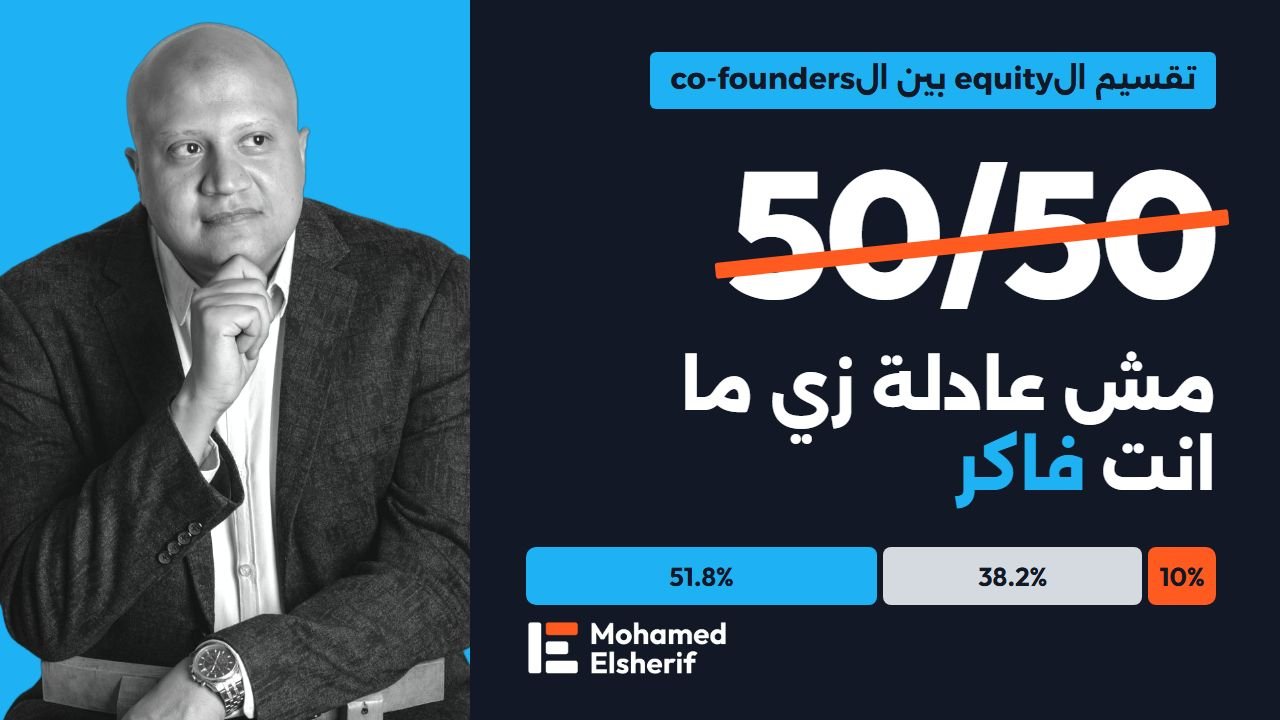
The sheet compares each founder to the total on each factor, applies the weights, and gives Omar 41% and Sara 59%. After a 10% option pool, that is Omar 37%, Sara 53%, pool 10%.
Not 50/50. And the day Omar goes full time, you go back to the sheet.
One note on cash: many founding teams treat money a founder puts in as a separate investment or a loan, on its own terms, rather than part of the split. If that is your agreement, set the cash weight to 0.
Vesting: equity you earn, not equity you are given
Vesting means your share is not all yours on day one. You earn it while you work in the company.
The common pattern is four years with a one-year cliff:
- Leave before the end of year one, and you take nothing.
- At month 12, a quarter of your share vests at once.
- The rest vests over the next three years, monthly or quarterly. Quarterly means 16 quarters in four years, so each quarter after the cliff adds one sixteenth.
| Month | 0 | 6 | 11 | 12 | 18 | 24 | 30 | 36 | 42 | 48 |
|---|---|---|---|---|---|---|---|---|---|---|
| Share earned | 0% | 0% | 0% | 25% | 38% | 50% | 63% | 75% | 88% | 100% |
This is normal, and investors expect it. What matters is that both of you understand it and agree to it before you need it.
The option pool: count it before your first round
Before a funding round, or before you give your first good engineer or first salesperson a share, you set equity aside. That is the option pool, sometimes called the employee pool. It is often around 10%.
It comes out of every founder’s share in the same proportion. If you have not created one, the investor will ask for it, and it will be taken from your shares then. So plan for the fact that the founders do not really own 100%.
If someone leaves: good leaver or bad leaver
This is the conversation most teams skip, and the one that ends friendships.
- Good leaver. Leaves for an understandable reason, such as health or family, or by agreement. A good leaver usually keeps what they have earned up to that point.
- Bad leaver. Leaves suddenly, joins a competitor, starts something similar on the side, or harms the company. A bad leaver usually loses most of it, and the company buys back what they had earned at a lower price.
At what price? Agree on it now, while you still agree on everything. How much does a bad leaver keep, how much do they give back, and what price does the company pay for it?
In the sheet’s example, Omar leaves after 18 months, so he has earned 37.5% of his 37% share, about 14% of the company:
- As a good leaver, he keeps that 14%, and the unvested 23% returns to the company.
- As a bad leaver, with the example terms (keeps half of what he earned, buyback at a 50% discount on an EGP 2 million valuation), he keeps about 7%, and the company buys the other 7% back for about EGP 70,000.
These terms are examples. Yours have to be written into your agreement with a lawyer.
Five questions before any percentage
Each founder answers these alone first. Then you compare.
- Who is full time, and since when?
- Who put money in, and how will you treat it?
- How many years is the vesting, and is there a cliff?
- If someone leaves, what happens to their share?
- If you disagree on a big decision, who has the final word?
If you have three, four or five founders, the method is the same. Only the number of rows changes.
The point of all this is not to expect the worst from each other. It is that if a disagreement does come, you both already know what happens, and you can solve it and keep working together.
Get the sheet
The sheet has five tabs: Start, Split, Vesting, Leaver and Checklist. The blue cells are the ones you fill in, the orange cells are the result, and the rest are formulas. It is in Arabic, with the financial terms in English, and works in Excel and Google Sheets.
Get the sheet
Leave your name and email and the Excel file downloads on the next page.
The sheet is a tool for the conversation, not legal, tax or valuation advice. The weights are a starting point, not a rule. Your final founders’ agreement should be written and reviewed with a lawyer. If you want to go further on that agreement, I wrote about what a founders’ agreement should cover.
Take it furtherTake it to a SaaS Clarity Call
Stay on top of MENA SaaS
Every week: what moved in the region’s SaaS industry, what it actually means, and the practical tips I would give a founder sitting in the room. Published on LinkedIn. Subscribe and it comes to your inbox too, with no algorithm in between.